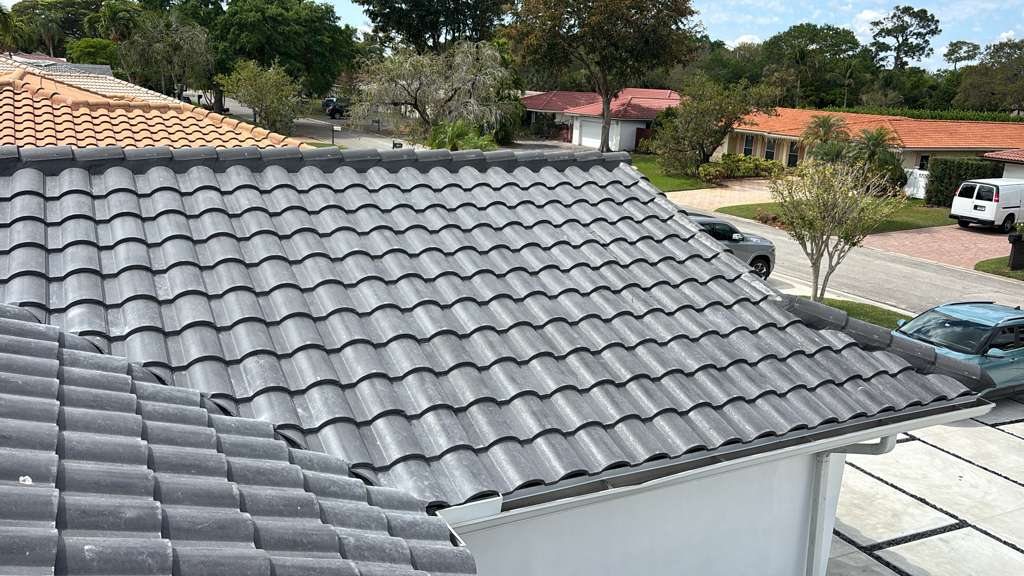
If you own a home or commercial property in South Florida and your roof is approaching the end of its life, two systems dominate the conversation: concrete or clay tile and standing-seam metal. Both perform well in our climate, both can meet Miami-Dade and Broward wind requirements, and both will outlast a standard asphalt shingle roof. The right choice comes down to budget, building style, and how long you plan to own the property.
Here is the honest comparison we give our own clients.
Up-front cost
For a typical single-family home in Broward or Miami-Dade, installed in 2026:
- Concrete tile: roughly $9–$14 per square foot installed.
- Clay tile: roughly $12–$20 per square foot — clay is heavier and more expensive than concrete but holds color longer.
- Standing-seam metal: roughly $11–$17 per square foot installed.
Tile and metal land in a similar range, and the spread inside each range depends far more on roof complexity — hips, valleys, dormers, and penetrations — than on the material itself. A simple gable roof is dramatically cheaper to install than a cut-up roof with multiple slopes, regardless of which system you pick.
A quick note on the cheapest quote: in a hurricane zone, the install matters as much as the material. Fastening pattern, underlayment, and proper flashing are what keep the roof on the building. Price a contractor’s method, not just their number.
Lifespan
This is where the two systems separate from asphalt and from each other:
- Concrete tile: 40–50 years.
- Clay tile: 50+ years — often outliving the structure underneath.
- Standing-seam metal: 40–60 years with proper coating.
Both are genuine long-term investments. The underlayment beneath tile, however, typically needs replacement around the 20–25 year mark even when the tiles themselves are fine — a real cost to budget for. Metal generally has no comparable mid-life service event.
Hurricane performance
In South Florida this is not optional. Every roof we install is engineered to the Florida Building Code and, in Miami-Dade and Broward, must carry a Notice of Acceptance (NOA) for the High-Velocity Hurricane Zone.
- Metal sheds wind exceptionally well and, when properly fastened, has no individual pieces to lift off. It is often the stronger performer in extreme wind.
- Tile also performs well when installed to current code with foam or screw-and-wire attachment, but older mortar-set tile can become wind-borne debris. If you are replacing an aging tile roof, modern attachment methods are a major safety upgrade.
Both systems are non-combustible, which matters for insurance.
Energy and comfort
Metal reflects solar heat and, with a reflective coating, can measurably lower attic temperatures and cooling bills — a real factor in our summers. Tile creates a ventilated air gap beneath each piece that also reduces heat transfer. Both outperform dark asphalt shingle. Call this category a draw, with a slight edge to coated metal.
Resale and curb appeal
Tile reads as “permanent” and suits the Mediterranean and Spanish architecture common across South Florida — it tends to match buyer expectations in those neighborhoods. Standing-seam metal has a clean, modern look that fits contemporary and coastal-modern homes and is increasingly desirable. Aesthetic fit with your home and street matters more for resale than the material in the abstract.
So which should you choose?
- Choose tile if your home’s architecture calls for it, you plan to stay long-term, and you want the longest possible service life.
- Choose metal if you want top-tier wind performance, energy savings, lighter weight (relevant on some structures), and a modern look.
There is no universally “better” roof — only the better fit for your building, your timeline, and your budget. If you want a straight answer for your property, request an estimate and we will walk the roof, check your wind zone, and give you real numbers for both options.
MTC General Contractors is dual-licensed for general contracting (CGC 1528440) and roofing (CCC 1333974) and builds across Broward, Miami-Dade, and Palm Beach counties.